Tencent Hy3: Free 295B MoE Model Now Available on Three Platforms
Tencent's 295B-parameter Hy3 model launched July 6 with free API access on OpenRouter, Hermes, and SiliconFlow. Benchmarks, platform comparison, and hands-on evaluation.
TL;DR: Tencent launched Hy3 (295B MoE / 21B active / 262K context) on July 6. Within 24 hours, OpenRouter, Hermes, and SiliconFlow added it with free API access — $0 per million tokens for both input and output. Benchmarks show it competes with Claude Opus 4.8 on coding and browsing tasks, but trails significantly on formal mathematics. Best for: engineering workflows, long-document processing, and agentic tasks. Not ideal for math-heavy workloads.
$0.00 per million tokens. 295 billion parameters. 262K context. Pick whichever number caught your eye first — they all describe the same model, and they’re all accurate.
Tencent shipped Hy3 on July 6, 2026, succeeding the widely-used Hy3 Preview that had been topping OpenRouter usage charts. Within 24 hours, three platforms — OpenRouter, Hermes, and SiliconFlow — added it with a :free tag.
A free 295B MoE model is unusual. But free models are a dime a dozen. What matters is whether it actually competes with the paid ones.
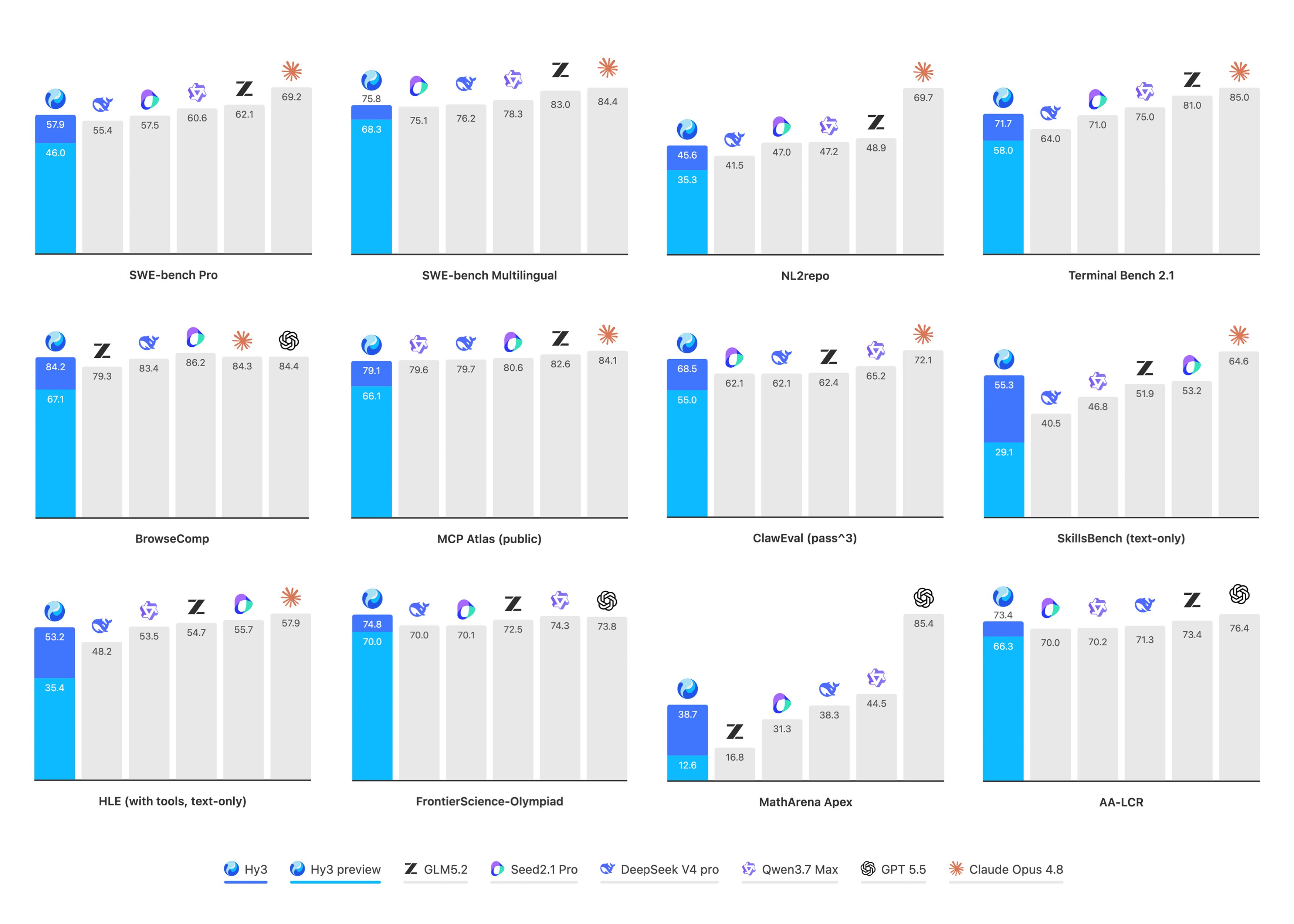
Against the Field: 12 Benchmarks
The official benchmark suite runs Hy3 against Claude Opus 4.8, GPT 5.5, GLM 5.2, DeepSeek V4 Pro, Qwen3.7 Max, and Seed2.1 Pro across 12 evaluations. A few results worth pulling out:
SWE-bench Pro (57.9). This measures real-world software engineering — fixing bugs, implementing features, navigating repos. Hy3 lands between DeepSeek V4 Pro (55.4) and Qwen3.7 Max (60.6). Claude leads at 69.2, but for a free model to sit in that bracket is unusual. For context on how this compares to other free-tier options, see our AI gateway comparison.
BrowseComp (84.2). This tests web browsing and information retrieval — finding answers across multiple pages, synthesizing results. Hy3 essentially ties Claude (84.3) and lands within noise of GPT 5.5 (84.4). BrowseComp correlates well with agentic workflows, which is where the market is heading.
Terminal Bench 2.1 (71.7). Command-line task completion. Hy3 beats DeepSeek V4 Pro (64.0) and Seed2.1 Pro (71.0), trails Claude (85.0) and GLM 5.2 (81.0). Respectable mid-tier showing for a free-tier model.
FrontierScience-Olympiad (74.8). Scientific reasoning. Hy3 matches Qwen3.7 Max (74.3) and beats GPT 5.5 (73.8) — impressive for a domain that typically favors larger dense models. This benchmark tests multi-step scientific problem-solving, a skill that transfers well to research-oriented engineering tasks.
MathArena Apex (38.7). This is the weak spot. GPT 5.5 hits 85.4. Hy3 is barely above GLM 5.2 (16.8). If your workload is heavy on formal mathematics — theorem proving, advanced competition problems — look elsewhere.
The pattern is clear: Hy3 excels at coding, browsing, and agentic tasks — areas where MoE architectures with strong routing tend to shine. It struggles on pure mathematical reasoning, which remains a dense-model advantage. This is consistent with what we’ve observed across other free cloud AI services.
Where It Pulls Ahead, Where It Falls Short
Strengths:
- Software engineering and debugging (SWE-bench, Terminal Bench)
- Multi-step information retrieval (BrowseComp)
- Scientific reasoning (FrontierScience-Olympiad)
- Long-context understanding (262K window)
- Three configurable thinking modes (light, standard, deep) letting you trade speed for depth
Weaknesses:
- Formal mathematics (MathArena Apex — 38.7 vs GPT 5.5’s 85.4)
- SkillsBench (55.3) — trailing Claude (64.6), though the gap to Seed2.1 Pro (53.2) is narrow
- Free tier may have rate limits and queue priority depending on platform
The simple version: if you write code, run engineering workflows, or process long documents, Hy3 holds its own against paid frontier models. If you need it to prove theorems, it’s not the right tool.
OpenRouter, Hermes, and SiliconFlow
All three platforms offer Hy3 with zero input and output token costs. The differences are in API features, rate limits, and additional capabilities.
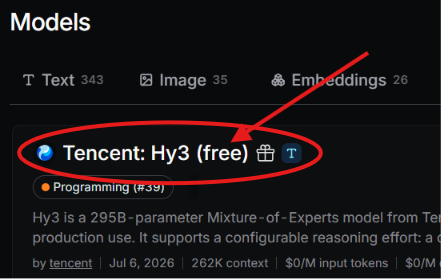
OpenRouter tagged it tencent/hy3:free within hours of launch. Their model page lists it under “Programming (#39)” — fitting, given the benchmark profile. A paid tencent/hy3 tier exists alongside it for higher rate limits. OpenRouter’s OpenAI-compatible endpoint means swapping base_url is the only integration change needed. OpenRouter is currently the most popular choice for Hy3 access based on community traction.
https://openrouter.ai/models/tencent/hy3:free
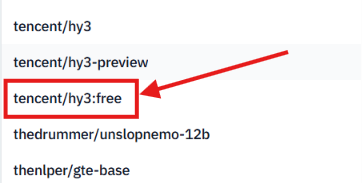
Hermes (by Nous Research) also picked it up fast — their interface shows tencent/hy3:free with the same zero-cost model list. Hermes acts as a model aggregator with a focus on surfacing newly released free models quickly. It serves as a reliable backup endpoint if OpenRouter experiences congestion, and its interface is clean for quick experimentation. Note that Hermes’ free model availability can fluctuate as providers update their offerings.
https://hermes.nousresearch.com/
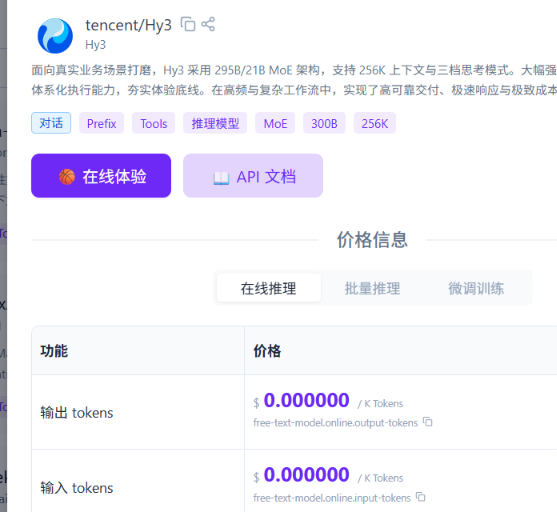
SiliconFlow (硅基流动国际站) offers the most capability beyond basic chat: online inference, batch inference, and fine-tuning. If you need to process thousands of examples or fine-tune on your own data, SiliconFlow is the only one of the three that supports it directly. Their dashboard also clearly labels the model architecture (295B/21B MoE, 256K context) and the three thinking modes. All at the same $0.000000/K tokens pricing makes this the most feature-rich option for production workflows.
https://siliconflow.com/models/tencent/hy3
Three Lines of Code
All three providers use OpenAI-compatible endpoints. Switching between them is a base_url change:
import openai

client = openai.OpenAI(
    base_url="https://openrouter.ai/api/v1",
    api_key="your-api-key"
)

response = client.chat.completions.create(
    model="tencent/hy3:free",
    messages=[
        {"role": "user", "content": "Explain what makes Hy3 different from other MoE models."}
    ]
)
print(response.choices[0].message.content)
Replace base_url with SiliconFlow’s or Hermes’ endpoint and you’re running on whichever platform suits your latency and concurrency needs.
Frequently Asked Questions
Is Hy3 really free, or are there hidden costs? All three platforms listed here charge $0 per million tokens for both input and output. The “free” tag on OpenRouter and Hermes means no payment method is required to start. However, free tiers typically have rate limits (requests per minute) and may queue during high traffic. SiliconFlow’s free tier requires an account but similarly has no token cost.
How does Hy3 compare to Hy3 Preview? Hy3 is the official stable release. Hy3 Preview was an earlier beta that had been topping OpenRouter usage charts since April 2026. The official Hy3 improves on benchmark scores, adds the three thinking modes, and comes with the same free-tier availability on launch partners. Our coverage of Hy3 Preview vs the official release is in our AI gateway benchmarks post.
Which platform should I use? For quick experimentation and lowest friction, OpenRouter. For batch processing or fine-tuning, SiliconFlow. For a backup endpoint when primary providers are congested, Hermes.
Back to that $0.00 number from the opening. It’s a strong hook, but it’s also temporary — these free tiers exist to build adoption, not as permanent infrastructure. The benchmark scores, though, are permanent. And they tell a straightforward story: Hy3 is competitive on the tasks that matter most for practical engineering work, at a price that won’t last. If you’ve been meaning to test a 295B MoE model against your actual workload, now is the time to do it.
This article was published on July 7, 2026. Pricing and availability may change. Last updated July 7, 2026.
OpenRouter: https://openrouter.ai/models/tencent/hy3:free Hermes: https://hermes.nousresearch.com/ SiliconFlow: https://siliconflow.com/models/tencent/hy3
Related reading
Comments
Join the conversation
A quiet margin for reflections after reading.
No comments yet. Be the first to leave a thought.